I’ve left off – just as I thought might happen – writing, but not thinking, about those things I notice that I take for granted. There are so many such things that sometimes I am stymied by the amount or, as I noted opening this note, I am unable to pick a starting point, a way ‘in’ to the thing taken for granted I want to write about.
I mean … I could go for the big one: that I live in a democratic republic (or is it a republican democracy?). But that would really stop me in my tracks, both because there is so much to say about it and because I would not know where to start.
All of that said … “I take for granted …” that at 73 we are still able to care for ourselves (though, we are not the best housekeepers). That is, we are still able to bathe, dress, prepare food, eat, and so many other things that make a life AND we are able to do them for ourselves, by ourselves.
I originally said it half seriously/half jokingly to the PA at our doctor’s office but that does not make it any less accurate in terms of this thing I take for granted: “I am still able to stand on one leg and pull on my pants, one leg at a time. And so long as I am able to do that I figure I’m okay.” But, there are mornings when it is easier (meaning less painful) to just sit on the edge of the bed and pull them on … slowly. Thankfully, those days are few but not always far between, depending on how much physical work I did the day(s) before.
It was while I was on a walk this morning (Jeeezus! It was cold out there this morning walking INTO the wind; and it seemed as though the wind was coming from every direction …) that this topic suggested itself to me, in part because being able to get out for a walk falls under this topic but, in a more immediate ‘sense’, I was ‘made aware’ of my taking for granted my ability to go for a longish walk unaided (or, for that matter, the ability to get up at 0530 today and bake off two loaves of sourdough bread): I was passed (twice!) by the City’s Meals-on-Wheels truck; the serivce is offered under their ‘Seniors Programs’, which are quite comprehensive.
‘Being made aware’, presuming of course that one is open to being made aware, is one of the methods by which we come to question – and, ideally – better appreciate those things we routinely take for granted. A chance encounter with something that or someone who calls our complacency into question is one of the most effective means of being made aware: it occurs independent of us, it intrudes on our ‘usual’ thoughts and acts, and it can force a reassessment if we are open to it (as, for example, I am through having decided to think and write about things I take for granted).
For lack of sleep, I rarely gave this notion a passing thought today. But, it strikes me that I can take an example from what we did this morning, and what was reinforced by a ‘memory post’ from 5 years ago made by Marc MacPherson: “I take for granted …” that, when I go to the grocery store to shop for specific items (today it was eggs, honey, coffee, and other things) I will find them, without difficulty.
“I take for granted …” that, as I step out of our bedroom into the dark living room and then into the kitchen, each light switch or lamp chain or knob when flipped, pulled, or turned will bring light; that when I adjust the thermostat to warm the house the furnace will turn on and blow warm air into the house; that the security system will turn on or off, as I wish, when I tell it to do so. All of these things are contingent on the availability of electricity – along with a variety of other integrated and integrating support systems.
Such ‘switch’ manipulations are done unconsciously with a barely acknowledged ‘expectation’ that the desired result will occur. As occurred just now after I looked up and noted the house thermostat indicating a lower than expected temperature (until I realized it was pre-programmed, by me, to return to 70° at a particular time … I even made a sort of mental note after adjusting the ‘heat’ as I left the bedroom that I’d have to reset it after 0600); I opened the App that controls the thermostat from my iPhone and raised it to 73° (two degrees above the current temperature so,as to force the heat to come on), without having to leave the sofa.
Things ALL taken for granted.
Can we consider these ‘things taken for granted’ – and, here, ‘things’ are not necessarily just objects but can include processes – as sites of a potential tension between ready-to-hand (Zuhandenheit) and present-at-hand (Vorhandenheit)? That is, so long as ‘things taken for granted’ function as expected, yielding the expected results, they remain ready-to-hand for use by us, not unlike the hammer of Heidegger. And, it is only when we acknowledge that ‘things taken for granted’ are indeed taken for granted and could ‘fail’ our expectations, or the failure actually occurs – like the heat and lights for the house not responding to my ‘commands’, that we experience those things as present-at-hand, that is, we wonder at and about them and their relation to us.
When ‘things taken for granted’ fail us – as many of them eventually will, if only temporarily – we are forced to re-examine our ‘relationship’ with those things.
We’ve had situations where the electricity ‘failed’ us. But it never failed for long (minutes to hours rather than days); and, it did eventually come back, much to our relief and comfort. A good stockpile of flashlights and sweaters, jackets, and blankets can mitigate an extended loss. Our gas fireplace works on a principle of thermoconductivity through its gas pilot such that it will continue to work despite a power failure throughout the house. We also have the beginnings of some sort of electrical independence: solar panels on the roof. But, to achieve full independence from the electrical grid, we still have to buy and have installed a battery system to provide power when the grid fails. Perhaps a small power source or generator is something we should consider, something to keep the iPhones charged, to power the refrigerator and freezer (so we do not lose the food we’ve set aside).
This note-able topic is the outgrowth of some ‘shower thoughts’, yesterday. But it is also very much related to our present political situation.
I had been toying with the notion of a diary-of-sorts, something of our time under Trump 2.0. The idea of a diary came from my reading of Victor Klemperer, specifically the introduction to his Language of the Third Reich. And that, working back, came from reading Timothy Snyder’s little book, On Tyranny.
But, the problem I keep running into with diaries is that, lacking a focal point on which to turn my thoughts and attention, I am dreadful about keeping them going. I seem to have no trouble starting; I just ‘lose interest’ … though that is not entirely accurate. Focus is a function not only of ‘interest’ but of time. And, well, time … how easily is that disrupted, breaking focus and damping interest?
And that is where, more or less while indulging in ‘shower thoughts’, I stumbled on the notion of things taken for granted. How hard would it be to keep a diary going thinking about and then meditating on things one routinely takes for granted? And we take a lot for granted … if nothing else this could also be an exercise in self- and other-awareness.
Example: “I take for granted …” the ‘fact’ that when I open a tap in/on the house, water will flow. Not just water but, rather, water that is clean, safe – in a word: potable. That water is assumed to always be ‘there’ ready to flow from the faucet so that I can then drink it, clean our dishes and clothes, clean my body, prepare our food, water our garden. I also know –albeit in a ‘first world’ sort of way – how discomfiting it can be to turn the knob or lift the ‘handle’ and unexpectedly have nothing come from the faucet … nothing, except maybe the sound of air moving in the piping.
From where does this taking ‘water’ for granted come? And, what can I do to disrupt the complacency behind such thought-less thinking? What can I do to make present the precarity of uninterrupted access to water?
The nature of things taken for granted seems to me to be their (sorry, Heidegger …) readiness-to-hand or Zuhandenheit, their ubiquity, their duration/durability, the ‘fact’ that we have never – or rarely ever – been without.
Reading Frank Herbert’s DUNE was an early wake-up call; subsequent readings have helped reinforce awareness. Living in the desert southwest – both as a child in the mountains around Los Alamos and now at the northern edge of the great Chihuahuan Desert – also helps with awareness. Metered water supplies, monthly water and sewage bills based on realtime use, the ability to log on to the City website and ‘see’ one’s water use in real time all contribute to water awareness.
So, each day – not necessarily at a specific time but, rather, as the time finds me or I find it – I will endeavor to identify and question (interrogate?) something I take for granted.
Coming back to The Perennial Student after so many years of not adding to it (despite it being on my browser home tabs page), it dawns on me that the last time I really engaged with the blog was FIVE years ago. At that time, I had been home only a couple of months after having traveled to New Orleans for an academic conference: the 2020 Conference for the International Society for the Study of Narrative (https://www.thenarrativesociety.org). At that time, we were only just learning about the extent of the COVID pandemic; in fact, I am not sure the word ‘pandemic’ had yet been used to describe it. But it was clear, while traveling through New Orleans, Houston, and El Paso to get home to Las Cruces, that something terrible was happening. And it was also abundantly clear that we were living in a political nightmare: Trump was POTUS and he was mismanaging the spread of a highly contagious and deadly respiratory disease. The airports I passed through getting home were eventually identified as ‘hot spots’ for the spread of the disease. I was lucky … I neither caught it nor brought it home with me.
At the time I made the post about the conference, we were in a form of social lockdown designed to prevent the spread of the disease.
Now, in 2025, we are once again dealing with a Trump ‘presidency’ … a whole new nightmare, about which I might write some other day. This is important because when – it is not a question of ‘if’ or ‘whether’ – the next pandemic strikes (could it be measles, as with the cases at the border area among New Mexico, Texas, and Mexico?) we will be dealing not only with a ‘president’ who routinely deals in dis-/mis-information, we will also be dealing with Robert F. Kennedy , Jr., as the Secretary of Health and Human Services. I believe that is all that need be said. His name is synonymous with anti-vaccine conspiracy theories.
So, as I said in the title of this post, we have awakened from one nightmare (Trump 1.0), and after a four year period of relative sanity and recovery, find ourselves back in the nightmare (Trump 2.0).
This post serves as an introduction to yet another attempt to re-awaken this blog and use it to think through things that catch my attention.
One of those things, only just noted, is that I misspelled ‘perennial’ in my domain name. Thankfully, I spelled it correctly in the site ‘name’. What was I thinking?!? Or, was this a compromise because the domain name I wanted, spelled correctly, was already taken? That sounds like a good cover story …
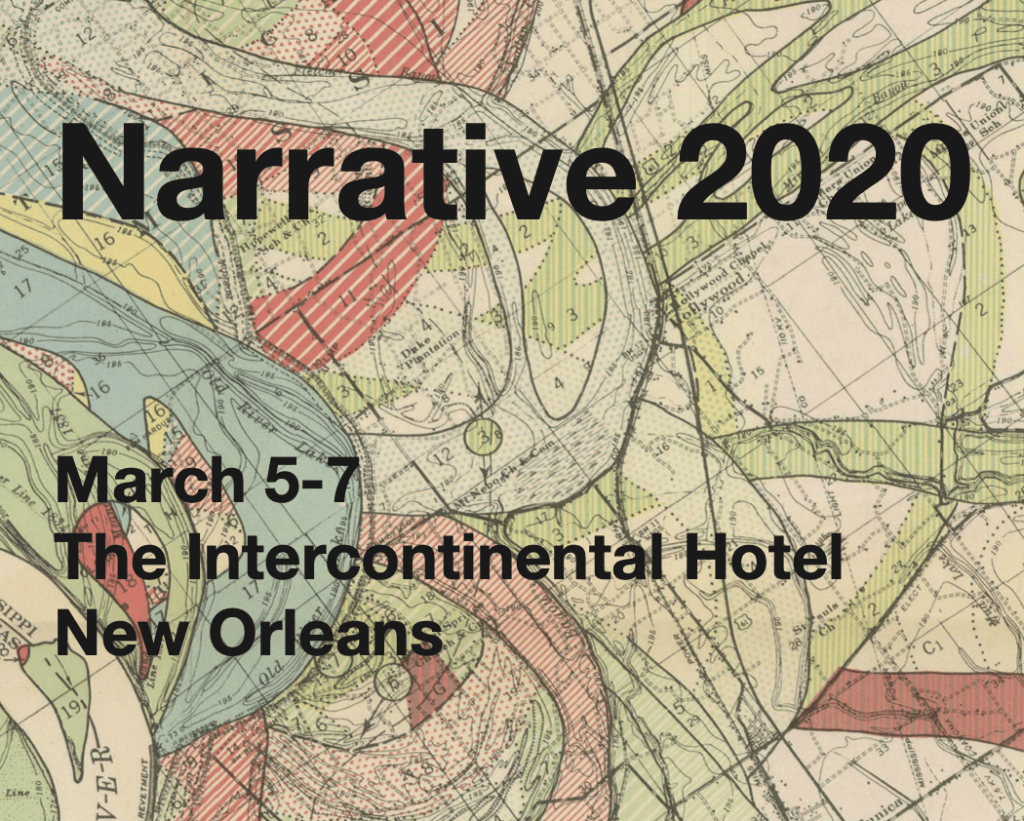
Screen capture of the cover of the Conference Program [https://www.narrative2020.org/program]
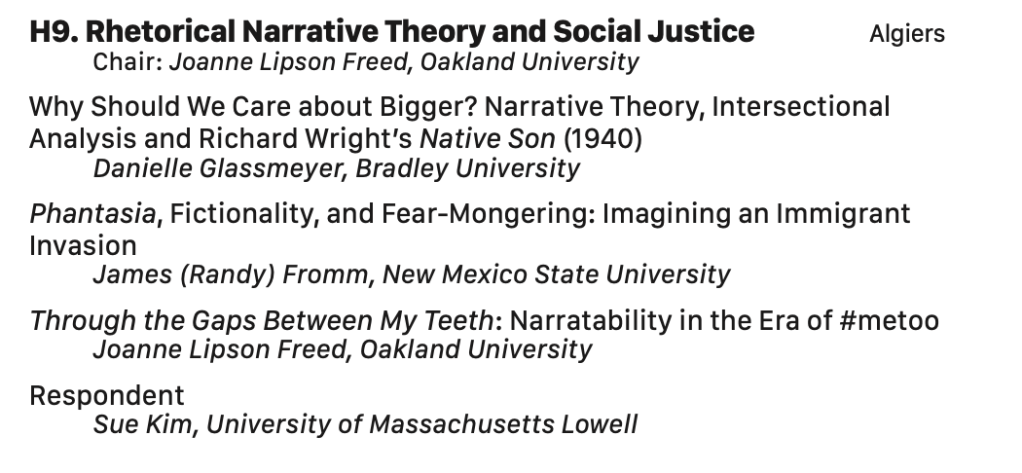
This last March, early and on the heels of Mardi Gras, The International Society for the Study of Narrative (ISSN) held its annual conference in New Orleans at The Intercontinental Hotel. This was only just before a number of conferences were cancelled out of an abundance of caution concerning the spread of COVID-19. I was fortunate enough to have been accepted as a part of a panel that took up and attended to the rhetorical aspects of narrative in relation to social justice. My co-panelists were Drs. Danielle Glassmeyer and Joanne Lipson Freed and our respondent was Dr. Sue Kim. It was my first panel with a prearranged respondent and I was in distinguished company.
Screen capture of program entry for Session H9
What follows in this post is the as-presented version of my paper, unedited other than to explain toward the end that, due to time constraints, the last two sections were glossed and the CODA was dropped. They are, though, important parts of the paper in terms of signaling where the work could point for further research and thought.
Phantasia, Fictionality, and Fear-Mongering: Imagining an Immigrant Invasion
Shootout at the Circle DUG Ranch
The Circle DUG Ranch,[1] a private game ranch and hunting preserve, is located in the extreme southwestern part of Texas, approximately ten miles northwest of Candelaria, the nearest town. Its history goes back to well before Texas became a state.[2] Candelaria is on the United States side of the Rio Bravo/Rio Grande, almost directly across the river from its Mexican neighbor, San Antonio del Bravo. Candelaria and San Antonio del Bravo were once—and to a certain extent still are—a closely coupled, transnational community, connected through kinship and economic relations. They were physically connected by a footbridge built by both towns’ residents.[3] In 2008, the Bush Administration removed the footbridge and destroyed the footings. Candelaria is now effectively a ghost town; San Antonio del Bravo is not far behind. Border crossings between the towns continue to this day, despite the removal of the foot bridge, ‘afforded’ and ‘encouraged’ by low river water levels and flow, a consequence of large-scale irrigation upstream and choking by localized silting and invasive plants, and—depending on the season—by easily set up and removed temporary rope ‘bridges’.
Sometime before 9:00 PM, on January 6, 2017, multiple gunshots rang out in the vicinity of the ranch house at the Circle DUG. Two men—a hunting guide and his client—were wounded, the guide seriously. Initial media reports (e.g., from Albuquerque Journal and Las Cruces Sun News), based principally on a statement provided by a friend of the family of the wounded guide, suggested that the shootout was an attack by ‘illegal’ and violent border crossers intent on more than merely stealing a recreational vehicle:
“The attack has the family concerned that the attack was not just an attempt to rob the property,” the [Gila Livestock Growers Association President’s] statement said. “They believe the assailants intended to kill all the party. The attackers were strategically placed around the lodge and the men were fired upon from different areas.”[4]
The Presidio County sheriff, who responded to a 911 call from the ranch, expressed skepticism: “We are still investigating details of the shooting […] However there is no evidence to support allegations of ‘cross border violence’ as released by some media sources.”[5]
The Argument
I suggest that this brief story, in a variety of ways and on multiple levels, exemplifies the conditions of Jim Phelan’s conception of narrative as a rhetorical act. That is, this story does rhetorical work through “somebody telling somebody else on some occasion and for some purposes that something happened” (2017, ix), whether that somebody telling is a reporter, the author of the ‘amicus brief’, or—on this particular occasion—me.
But what is (that) rhetorical work?
And, how is it brought about, particularly from and in relation to story?
Today, I am not so much interested in ‘story’ in the way we think of it as the something happened that someone tells someone else—though that is an aspect that lurks in the background. Rather, the nexus of my paper emerges from one possible intersection, as is suggested by the title, of four terms: narrative, fictionality, phantasia [φαντασία] (or ‘imagination’ understood broadly), and rhetoric. It is the last of these that provides the critical lens through which I focus upon the other three to get at the rhetorical work of what I call ‘border stories’ or stories that circulate around, in, and across—in this particular case—the Mexico-U.S. border and borderlands. And, more importantly, the related rhetorical ramifications that extend well beyond the border region into the imaginations—and fears—of some audiences.
Some Terministic Housekeeping
Some situating remarks on my use-related understandings of those four terms are appropriate.
First, narrative: In what follows, the words ’story’ or ‘narrative’ refer to what Phelan calls “a multidimensional purposive communication from a teller to an audience” (2017, 5). But the ‘teller’ in my approach may not be a ‘who’ so much as a ‘what’ and, crucially, multiple. Additionally, despite the stories I take up being ostensibly non-fiction (news stories are supposed to be non-fiction, right?), when I refer to an audience I intend all four audiences identified by Phelan: the flesh-and-blood reader; the authorial audience that “shares the knowledge, values, prejudices, fears, and experiences that the author expect[s] in his or her readers” (2017, 7); the narratee; and, the narrative audience that is “an observer position within the storyworld” (ibid, my emphasis). Phelan reserves this last for fictional narratives on the premise that immersion within a storyworld, and all that that entails, occurs only when the audience “regard[s] the characters and events as real rather than invented, […] accept[ing] the whole storyworld as real” (ibid; my emphases). In my cases, the authorial audience and the narrative audience meet and interact in rhetorically suggestive ways.
Second, fictionality: From Richard Walsh, I take fictionality in stories or narratives to be “a distinctive rhetorical resource, functioning directly as part of the pragmatics of serious communication” (2007, 1). Specifically, I am interested by the notion that “[f]ictionality is founded upon a basic human ability to imagine,” which some of you will recognize as the first of ten theses about fictionality (Nielsen, Phelan, and Walsh 2015, 63).[6]
Which introduces the third term, phantasia: While it is generally translated as ‘appearance’ or ‘presentation to consciousness’ or ‘imagination’ of visual images, I extend phantasia to the environmental impressions on/of the full human/animal sensorium, much as Plato does in Theatetus when contrasting ‘seeming’ (φαντασία) and ‘perception’ (αἴσθησις) in response to internal and external stimuli,[7] or as Quintilian does in his Institutio Oratoria when describing the use of pathetic (that is, emotional) appeals in the courts to stimulate ‘visions’ (visiones, φαντασίαι) and feelings in the minds and bodies of the jurors.[8] Because his discussion of phantasia in De Anima (On the Soul) is one of the most comprehensive expositions we have, Aristotle dominates the discourse about its role in rhetoric. He concludes, in short: without our sensory apparatus, we have no phantasia; and, without phantasia, we have no—or, crucially, are not moved to—judgment.[9] Consequently, phantasia has a role in any suasive situation.
I take up phantasia in two ways: first, the ‘civic’ phantasia of Michele Kennerly (RSQ 40(3), 2010), theorized as a driving force for, or as the means of, moving persons to judgment and, potentially, public action; second, Debra Hawhee’s sense of phantasia as a kind of aisthesis, or weak mode of perception,[10] in which feeling aisthesis (sensory input) is bundled and bridged over to deliberative aisthesis (cognitive appreciation and apprehension). Kennerly, more explicitly than Hawhee, takes up phantasia as it works in both the rhetor and the audience in a push-pull relation: phantasia is not a one-way street, running simply from one’s sensation to one’s perception; rather, it can function civically, analogous to a taut string running between two tin cans that moves vibrations, or disturbances, between the cans, allowing two-way communication. In this way, sensation, through phantasia/imagination, affects or moves our perceptions; and, going the other way, our perceptions, through imagination, affect or move our feelings and sensations.[11]
Finally, rhetoric: The Western Rhetorical Tradition is grounded in Aristotle’s instrumental approach through his Art of Rhetoric: “Rhetoric then may be defined as the faculty of discovering the possible means of persuasion in reference to any subject whatever” (14-15, my emphasis).[12] Within its logic, Aristotle’s rhetoric presumes a ‘rhetorical situation’ in which a speaking (or writing) human agent, the rhetor, addresses a particular audience on the basis of some exigence.[13]Contemporary reconsiderations of what rhetoric is take up what it does in terms of effects and affects, as well as how it does it.[14] My work is informed by a rhetoric forwarded by Carole Blair, Greg Dickinson, and Brian L. Ott [in their introduction to the edited volume, Places of Public Memory: The Rhetoric of Museums and Memorials]:
Rhetoric is the study of discourses, events, objects, and practices that attends to their character as meaningful, legible, partisan, and consequential. […] [I]t organizes itself around the relationship of discourses, events, objects, and practices to ideas about what it means to be ‘public’. (Blair, et al. 2010, 2)
Faint echoes of Aristotle’s definition can be heard here. What has changed most significantly is the introduction of non-human agents into a system of relations—an ecology, if you will—that exhibits suasive practices and affects.
Walsh’s rhetoric of fictionality and Phelan’s Author-Resources-Audience model (2017, 26) are, through Wayne Booth’s rhetoric, grounded in Aristotle’s instrumental definition of rhetoric: the resources available to an author are “the possible means of persuasion” of the reader in a particular narrative/rhetorical situation. Today, I want to push beyond the author as rhetor in a rhetorical/narrative situation to also take into account ‘ambient rhetorics’ (Rickert 2013, 1-31) emerging from non-human agents acting or participating in a rhetorical ecology.[15] Think, for example, of the suasive power of a speed bump within an ecology of parents, children, residential neighborhoods, schools, cars and trucks, speed limits, police officers, speed traps, and various traffic control strategies: you are, are you not, ‘encouraged’ (or are you ‘persuaded’?) to slow down, when driving over one, in ways not at all like the ways the other rhetorical agents might encourage you? Now, extend that image to the rhetorical work done by a story in which one of the non-human agents in the bounding but continuously changing rhetorical ecology is an international border, and a particularly fraught border at that.
Interpolated Interpellations and Fear-Mongering
Facts are funny things. They generally don’t go away. They resist erasure. But, they are susceptible to manipulation.
FACT: multiple shots were fired in the late evening of January 6, 2017, at a remote Texas game ranch near the border with Mexico.
FACT: two men, a hunting guide and his client, were wounded, the guide seriously.
Yet, in the first publicly available story about the event, published online, in a blog, the day before the story hit the local newspapers, a rhetorically compelling fiction was built incorporating those facts. In part:
“Per a family source, everyone was in bed preparing for an early hunt, the guides and cooks inside the house and the clients in the rental RV parked nearby. Walker [Daugherty] heard voices outside and went to see what the noises were, he witnessed men with guns attempting to take the RV, he then ran back inside to get help. Walker and Michael [Bryant] armed themselves to defend and protect the client and to attempt to deter the assailants while the hunter attempted to escape in the RV which was being shot at repeatedly. The vehicle is riddled with bullet holes from the attack and suffered other structural damage.
“The attack lasted long enough for Walker to run back to the house and get more ammunition, when he was close to the door his sister, saw him get shot and was able to drag him inside the house and away from the gunfire. The women in the lodge were able to get a spotty cell signal and call 911.
“The family has been earning a living guiding and outfitting out of the remote ranch for years. The business had experienced several thefts and had been working with the US Border Patrol to apprehend illegal aliens in the area in the past month. The theft events and the attack occurred in the United States.”[16]
The empty spaces around and between the indisputable facts of the event were filled with what I call interpolated interpellations. Rhetorically speaking, the someone told is haled by the someone telling to imaginatively (because they were not present at the time/place of the event) attend to particular suasive suggestions and the associated rhetorical ramifications amplified through the affective aspects of the interpolated story elements: family, home, men with guns, defend and protect, assailants, being shot at repeatedly, attack, more ammunition, get shot, dragged to house by sister, more gunfire, women in the lodge, spotty cell signal, 911 call, history of thefts, illegal aliens . . . and it all occurred IN THE UNITED STATES.
It is in the haling of the someone told that some flesh-and-blood readers become or occupy the role of, first, the authorial audience, then the narratees, and finally the narrative audience, immersed in the story as interested and invested observers. At that last transition, fear—defined by Aristotle as “a painful or troubled feeling [ταραχὴ] caused by the impression [φαντασίας] of an imminent evil that causes destruction or pain” (Rhetoric 200-201)—enters the emerging rhetorical ecology as an impending invasion by “illegal aliens.”
Within a week of the event, following extensive investigation by multiple law enforcement agencies, no sign or trace of persons other than the hunting guides and their clients were discovered; this included foot/vehicle traffic around the lodge and bullet-riddled RV and the collected fresh brass from the discharged weapons. Everything tangible pointed to a friendly fire event, not to cross border violence, not to the imaginatively (in the inventive sense) crafted story. So, why invent an elaborate story?
Phantasia and Fear-Mongering: from Little, Local Stories to Grand, Global Narratives
From this situation, an interanimating, mutually constitutive cyclic relation between at least two states of motivated tellings emerges: little, local stories told by ‘entities’ and grand, global narratives enacted by social systems. Stories like “Shootout at the Circle DUG Ranch” and, if we have time to get to it, “Dry-gulched Near Big Bend,” are examples of little, local stories.[17] They are ‘little’ in length, ‘little’ in scope (that is, scene, actors, events, complexity of presentation), and ‘little’ in duration in the attention spans of audiences, if they capture any lasting attention at all. They are ‘local’ in that they occur in a small, contained space/place, proximate to the initial authorial audience, though other, broader audiences can and do get involved as the story gains traction and ‘sticks’ to related events. It tellingly highlights the little, local criteria that many people in the Las Cruces/El Paso corridor with whom I spoke informally about “Shootout” either knew nothing about it or only vaguely recalled having heard something about ‘hunters shooting each other’ (which, as we know since at least the Bush-Cheney Administration, is apparently not unusual in Texas). That may, though, say more about the rhetorical ecology within which I was asking questions.
The affective aspects and rhetorical ramifications of little, local stories like “Shootout” gain traction by embodying and enacting elements of larger, intersecting rhetorical ecologies manifest in grand, global narratives. Such narratives are ‘grand’ in a totalizing and essentializing sense—for example, the narrative of American Exceptionalism. They are ‘global’ in at least two ways. First, the elements of grand narratives have local analogues in the lived experience of individuals all over the world. Second, they support similar “structures of feeling” world-wide, in communities where similar rhetorical ecologies thrive; for example, in the cases I am considering, this could be any community where international borders, fraught immigration and refugee crises, and groups fearful of and hateful toward the ‘other’ collide and rub up against one another. Among the grand, global narratives that feed and feed on stories like “Shootout” is the “Immigrant Invasion” narrative, pushed by some persons and groups (other related narratives might more or less explicitly invoke white supremacy, white nationalism, vigilance and vigilantism, or something as innocuous sounding as keeping our streets safe for our children).[18]
CONCLUSION(S): Social Justice and (Ir)Responsible Rhetorics
I opened my paper asking: “what is rhetorical work? And, how is it brought about, particularly from and in relation to story?” The ‘civic’ phantasia envisioned by Michele Kennerly helps shape my understanding of rhetorical work: rhetoric “giv[es] presence to the unseeable—something not yet or never capable of being seen—or to the unseen—something visible but ignored” (269; emphases in original). This notion of ‘giving presence’ connects fruitfully with what I take to be at the heart of social justice: our ability to imagine ourselves in the situations of others—to, as Diane Davis puts it, acknowledge our response-ability through imaginative identifications—and ‘feel’ their human dignity.[19]
In Poetic Justice: The Literary Imagination and Public Life, Martha Nussbaum writes, “novel-reading will not give us the whole story about social justice, but it can be a bridge both to a vision of justice and to the social enactment of that vision” (12; my emphasis). Because phantasia or, as Nussbaum calls it, ‘fancy’ working in and on rhetorical ecologies can either build or destroy that bridge to vision and enactment, I believe that in addition to novel-reading close critical attention to the rhetorical relations among little, local stories and grand, global narratives is necessary for a more complete understanding of social justice and our role in it. Rhetorics that hale us and in doing so call our attention to our response-ability to human dignity are responsible rhetorics. Those that operationalize or instantiate positions that close off or deny such response-ability are irresponsible.
[Delivered paper ended at this point but the final two sections were quickly glossed due to time constraints.]
CODA—time permitting: Dry-Gulched near Big Bend
United States Interstate Highway 10 runs across southern Texas from El Paso, through San Antonio, and on to Houston and the Louisiana state line. Along the way, particularly in the vicinity of the Big Bend, the highway is irregularly bisected by arroyos and associated concrete culverts that run under it. Some culverts have ‘jersey’ barriers; some have guardrails; but, a number of them have neither. And, except around the few towns dotting the route, none are lighted, making night driving an exercise in multi-sensory focus.
Sometime, in the late-night hours of November 18th or the very early morning of November 19th, 2017, two Customs and Border Protection agents were injured—one fatally—while responding, separately, to a triggered monitoring device, in the vicinity of Interstate 10, east of Van Horn. As reported by the Acting Secretary of Homeland Security:
“Earlier this morning, I was notified that Border Patrol Agent Rogelio Martinez died as a result of serious injuries suffered while on patrol in the Big Bend Sector of our southern border in Texas. Agent Martinez was responding to activity while on patrol with another agent, who was also seriously injured. We are fully supporting the ongoing investigation to determine the cause of this tragic event.”[20]
A subsequent press release by Customs and Border Protection was consistent with the Acting Secretary’s statement:
“Agent Rogelio Martinez and his Big Bend Sector partner were responding to activity while on patrol near Interstate 10, in the Van Horn Station area. Agent Martinez’s partner reported that they were both injured and in need of assistance. Responding agents provided immediate medical care, and transported both agents to a local hospital.”[21]
Multiple state and federal law enforcement agencies responded to the event. Searches of the surrounding showed no signs of unusual foot traffic or scuffling in or around the culvert in which Agent Martinez was found. The post-mortem report on Agent Martinez showed no defensive wounds and all injuries were on the right side of his body. The cause of death was “blunt injuries of the head.” While the injuries were consistent with a fall from some height, the manner of Agent Martinez’ death remains undetermined.
Yet a significant number of people still believe that he was ambushed by ‘illegal immigrants’.
Unlike “Shootout,” this particular story went national—and even international—almost immediately. At least part of the reason for that can be attributed to the rhetorical ecology within which it developed, including: the proximity of the event to the borderlands; the immigration, refugee, and drug-smuggling ‘crises’; and the political posturing of the Governor of Texas, Texas Senator Ted Cruz, and the newly elected President of the United States. Yet, much like “Shootout,” “Dry-gulched” was a little, local story the rhetorical work of which was amplified by the grand, global narratives from which, in part, it drew increased significance and which it served to amplify in the degree to which it affirmed and supported those same grand, global narratives.
References/Works Cited
Ahmed, Sara. The Cultural Politics of Emotion, 2nd edition, Edinburgh University Press, 2014, Ediburgh.
Anker, Elisabeth R. Orgies of Feeling: Melodrama and the Politics of Freedom. Duke University Press, 2014, Durham.
Aristotle. Art of Rhetoric. Translated by J. H. Freese. Loeb Classical Library 193, Harvard University Press, 1926, Cambridge.
—. On the Soul. Parva Naturalia. On Breath. Translated by W. S. Hett. Loeb Classical Library 288, Harvard University Press, 1957, Cambridge.
Bamberg, Michael and Molly Andrews (editors). Considering Counter-Narratives: Narrating, Resisting, Making Sense. John Benjamins, 2004, Amsterdam.
Birkerts, Sven. “Reading and Depth of Field.” Philosophy and Literature, vol. 20, no. 1, 1996, pp. 122-129.
Bitzer, Lloyd F. “The Rhetorical Situation.” Philosophy and Rhetoric, vol. 1, no. 1, 1968, pp. 1-14.
Booth, Wayne C. The Rhetoric of Fiction. 2nd Edition. The University of Chicago Press, 1983, Chicago.
—. The Rhetoric of Rhetoric: A Quest for Effective Communication. Blackwell Publishing, 2004, Malden, MA.
Butler, Shane and Alex Purves (editors). Synaesthesia and the Ancient Senses. Acumen, 2013, Durham, UK.
Charland, Maurice. “Constitutive Rhetoric: The Case of the Pueple Québécois.” Quarterly Journal of Speech, vol. 72, no. 2, 1987, pp. 133-150.
Davis, Diane. “‘Addicted to Love’; Or, Toward an Inessential Solidarity.” Journal of Advanced Composition, vol. 19, no. 4, 1999, 633-656.
—. Inessential Solidarity: Rhetoric and Foreigner Relations. University of Pittsburgh, Press, 2010, Pittsburgh.
Gross, Daniel M. “Heidegger’s 1924 Lecture Course on Aristotle’s Rhetoric: Key Research Implications.” Philosophy and Rhetoric, vol. 50, no. 4, 2011, pp. 509-527.
Hawhee, Debra. “Toward a Bestial Rhetoric.” Philosophy and Rhetoric, vol. 44, no. 1, 2011, pp. 81-87.
—. “Looking into Aristotle’s Eyes: Toward a Theory of Rhetorical Vision.” Advances in the History of Rhetoric, vol. 14, no. 2, 2011, pp. 139-165.
—. “Rhetoric’s Sensorium.” Quarterly Journal of Speech, vol. 101, no. 1, 2015, pp. 2-17.
—. Rhetoric in Tooth and Claw: Animals, Language, Sensation. University of Chicago Press, 2017, Chicago.
Kennedy, George A. “A Hoot in the Dark: The Evolution of General Rhetoric.” Philosophy and Rhetoric, vol. 25, no. 1, 1992, pp. 1-21.
Kennerly, Michele. “Getting Carried Away: How Rhetorical Transport Gets Judgment Going.” Rhetorical Society Quarterly, vol. 40, no. 3, 2010, pp. 269-291.
Leslie, Andrew. “How Stories Argue: The Deep Roots of Storytelling in Political Rhetoric.” Storytelling, Self, Society, vol. 11, no. 1, 2015, pp. 66-84.
Leuprecht, Christian, and Todd Hataley, Sophia Moskalenko, and Clark McCauley. “Winning the Battle but Losing the War?: Narrative and Counter-Narratives Strategy.” Perspectives on Terrorism, vol. 3, no. 2, 2009, pp. 25-35.
Linke, Uli and Danielle Taana Smith (editors). Cultures of Fear: A Critical Reader. Pluto Press, 2009, London.
McKerrow, Raymie E. “Critical Rhetoric: Theory and Praxis.” Communication Monographs, vol. 56, 1989, pp. 91-111.
Mercieca, Jennifer. Founding Fictions. University of Alabama Press, 2010, Tuscaloosa.
Moïsi, Dominique. The Geopolitics of Emotion: How Cultures of Fear, Humiliation, and Hope are Reshaping the World. Doubleday, 2009, New York.
Nielsen, Henrik Skov, James Phelan, and Richard Walsh. “Ten Theses on Fictionality.” NARRATIVE, vol. 23, no. 1, 2015, pp. 61-73.
—. “Fictionality as Rhetoric: A Response to Paul Dawson.” NARRATIVE, vol. 23, no. 1, 2015, pp. 101-111.
Nussbaum, Martha. Poetic Justice: The Literary Imagination and Public Life. Beacon Press, 1995, Boston.
Phelan, James. Narrative as Rhetoric: Technique, Audiences, Ethics, Ideology. Ohio State University Press, 1996, Columbus.
—. “Rhetoric, Ethics, and Narrative Communication: Or, from Story and Discourse to Authors, Resources, and Audiences.” Soundings, vol. 94, nos. 1/2, 2011, pp. 55-75.
—. Somebody Telling Somebody Else: A Rhetorical Poetics of Narrative. Ohio State UP, 2017, Columbus.
—. “Authors, Resources, Audiences: Toward a Rhetorical Poetics of Narrative.” Style, vol. 52, nos. 1-2, 2018, pp. 1-34.
Plato. Theaetetus. Sophist. Translated by Harold North Fowler. Loeb Classical Library 123, Harvard University Press, 1921, Cambridge.
Polvinen, Merja. “Enacting the Artifice: A cognitive Approach to Literary Self-Reflection.” SCAS Presentation, November 12, 2019. https://vimeo.com/384741581. Accessed January 20, 2020.
Quintilian. Institutio Oratoria. Translated by H.E. Butler. Loeb Classical Library, Volumes I-IV. William Heinemann Ltd., 1969 (124), 1966 (125 and 126), 1968 (127), London.
Rickert, Thomas. Ambient Rhetoric: The Attunements of Rhetorical Being. University of Pittsburgh Press, 2013, Pittsburgh.
Rood, Craig. “Rhetorical Closure.” Rhetorical Society Quarterly, vol 47, no. 4, 2017, pp. 313-334.
Vatz, Richard E. “The Myth of the Rhetorical Situation.” Philosophy and Rhetoric, vol. 6, no. 3, 1973, pp. 154-161.Vicaro, Michael Paul.
Vicaro, Michael Paul. “Deconstitutive Rhetoric: The Destruction of Legal Personhood in the Global War on Terrorism.” Quarterly Journal of Speech, vol. 102, no. 4, 2016, pp. 333-352.
Vila, Pablo. Crossing Borders, Reinforcing Borders: Social Categories, Metaphors, and Narrative Identities on the U.S.-Mexico Frontier. University of Texas Press, 2000, Austin.
Webb, Ruth. Ekphrasis, Imagination and Persuasion in Ancient Rhetorical Theory and Practice. Routledge, 2016, New York. [First published by Ashgate in 2009.]
Wells, Justine, et al. “Introduction: Rhetoric’s Ecologies.” In Tracing Rhetoric and Material Life: Ecological Approaches. Edited by Bridie McGreavy, Justine Wells, George F. McHendry, Jr., and Samantha Senda-Cook. Palgrave, 2018, Cham, Switzerland.
Yunis, Harvey. “How do the People Decide? Thucydides on Periclean Rhetoric and Civic Instruction.” The American Journal of Philology, vol. 112, no. 2, 1991, pp. 179-200.
—. Taming Democracy: Models of Political Rhetoric in Classical Athens. Cornell University Press, 1996, Ithaca.
[6] Merja Polvinen in her recent Swedish Collegium for Advanced Study (SCAS) presentation, “Enacting the Artifice,” contributes to my thinking here. She cites Colombetti and Thompson: “[L]iving beings are autonomous agents that actively generate and maintain their identities and thereby enact or bring forth their own cognitive domains” (2008, 55). Crucial to that enactment is the way the cognitive domain shapes and changes the individual, who (en)acts so as to change the cognitive domain, which . . . and so on. I see this as related to the way phantasia operates within a rhetorical ecology.
[7] Cf., 152c: “Φαντασία ἄρα καὶ αἴσθησις ταὐτὸν ἔν τε θερμοῖς καὶ πᾶσι τοῖς τοιούτοις,” that is, “Then seeming (φαντασία) and perception (αἴσθησις) are the same thing in matters of warmth and everything of that sort” (42-43).
[8] Cf. 6.2.26-6.2.35: in particular, “The person who will show the greatest power in the expression of emotions will be the person who has properly formed what the Greeks call phantasiai (let us call them ‘visions’), by which the images of absent things are presented to the mind in such a way that we seem actually to see them with our eyes and have them physically present to us” (58-61).
[10] Cf. Rhetoric, 1370a 6, note b. In Rhetoric, Book III, late in Chapter 10 and into Chapter 11, Aristotle also lays out the importance of metaphor in suasive strategies. Without actually using the word phantasia, he speaks of ‘bringing-before-the-eyes’ of an audience the locations and events of interest to the case at hand. Debra Hawhee has taken up this vehicle of transmission as the basis for a ‘rhetoric of vision’, as distinct from the ‘visual rhetoric’ one associates with film and photographs and the visual arts.
[11] Kennerly develops and presents her ‘civic’ sense of phantasia through three cases: Gorgias’ Encomium of Helen, Cicero’s prosecution of Verrus before the Roman Senate, and Thomas Paine’s pamphlet, Common Sense. Perhaps a more affective example here would be to consider Sara Ahmed’s discussion of “affective economies” in relation to Audre Lorde’s experience of ‘emotion’ on a New York City subway (2014).
[12] Because Aristotle’s techné (art) examines suasive strategies and their bases, this ‘definition’ is usually reduced to ‘rhetoric is the art of persuasion’—which is a terrible misreading of Aristotle.
[13] The idea of the ‘rhetorical situation’ by that name is attributed to Lloyd Bitzer, who first suggested it in the opening article of the premiere issue of Rhetoric & Philosophy, in 1968. It has been pretty much continuously critically engaged since then, most infamously by Richard E. Vatz, in 1973.
[14] There is the ‘constitutive’ definition: rhetoric as a discursive practice that calls some one or some thing into being; Maurice Charland’s analysis of the rhetoric that led to the ‘birth’ of the Parti Québécois is taken as the start of this approach to rhetoric (QJS 1987). Interestingly, Charland’s work has been turned back on itself in the theorizing of ‘de-constitutive’ rhetorics in recent work by Michael Paul Vicaro (QJS 2016). And, related to rhetorics of de-constitution, there is rhetoric as a means of quashing discourse, the ‘rhetoric of closure’ theorized by Craig Rood (RSQ 2017). These are just a few of myriad ‘understandings’ of rhetoric that serve particular ways of looking at (in yet another definition) “how human being is in the world through language” (Daniel M. Gross 2017, 512, emphasis in the original).
[15] In Ambient Rhetorics: The Attunements of Rhetorical Being, Thomas Rickert calls for a new conception of rhetoric: “Rhetoric can no longer remain centered on its theoretical commonplaces, such as rhetor/subject, audience, language, image, technique, situation, and the appeals accomplishing persuasive work, at least as they are predominantly understood and deployed. Rather, it must diffuse outward to include the material environment, things (including technological), our own embodiment, and complex understanding of ecological relationality as participating in rhetorical practices and their theorization” (3). The idea of a ‘rhetorical ecology’ is credited to Jenny Edbauer (Rice). In “Unframing Models of Public Distribution: From Rhetorical Situation to Rhetorical Ecologies,” Rice argues for the rhetoricity of “network[s] of lived practical consciousness or structures of feeling” (RSQ 35(4) 2005, 5).
[16] The full ‘story’ can be accessed online: “NM Hunting Guide, Client Wounded on Mexico border.” THE WESTERNER, January 8, 2017, https://thewesterner.blogspot.com/2017/01/nm-hunting-guide-client-wounded-on.html?m=1; posted by Laura Bryant, aka Laura Schneberger, Rancher and Gila Livestock Growers Association President; my interpolations in square brackets.
[17] There may also be a loose relation to what some are theorizing as ‘small stories’, a thread to be pulled later. See, for example, Small Stories, Interaction and Identities, by Alexandra Georgakopolou, Studies in Narrative 8, 2007.
[18] In A Different Mirror: A History of Multicultural America, Ronald Takaki identifies a number of grand, global narratives that circulate around what he calls the “Master Narrative of American History,” which acts as a filter through which some Americans view ‘other’ Americans suspiciously.
[19] Cf. Inessential Solidarity: Rhetoric and Foreigner Relations, especially “Introduction: A Rhetoric of Responsibility.” In Davis’ work, ‘response-ability’ and responsibility are connected through “an affectability or persuadability” necessary for symbolic action (2; emphases in original).
Each July, for the last several years, Laurie and I have made what has become a pilgrimage to Santa Fe where I have been a participant in the American Society for Aesthetics Rocky Mountain Division (ASARMD) Conference. Last year (2019), while Laurie finally had the opportunity for some extended wandering in the markets and museums and galleries, I chaired two excellent panels and delivered a paper. This post is about my paper; I will post later about some of the panels I attended and those I chaired.
First, the full text of my paper, as delivered. Then some discussion of the comments and suggestions it generated.
Noisome Utterances: A Speculative Essay Toward an Aesthetics of Annoyance
My paper today emerges, in part, from some of the possible intersections among my dissertation-related musings, research into imagination and affect within the civic ‘sphere’, the more shadowed affects and effects of our current US—if not world—political situation, and my abiding interest in the intersections between Classical Rhetoric and Aesthetics.
The proximate cause of taking up the notion of noisome utterances as a point of entry for this project was observation of the annoying antics of Representative Jim Jordan of Ohio during his opening remarks at the most recent round of Michael Cohen Congressional hearings—though I was aware of his interrogation techniques from the Secretary Clinton hearings—and thinking, at the time, about the rhetorical and, dare I say, poetical (in the sense of ‘making’ and ‘theatric’) aspects of his performance. A video example might be appropriate at this point but for the time it would consume and the annoyance it might cause; though that latter consequence might also help me make my point.
My
approach to this project, as it continues to develop, will be autoethnographic
and phenomenological, working from ’thick descriptions’, in the sense of Ryle
and Geertz, of my own lived experience of annoyance.
Starting, then, we have some crucial definitions and connections:
The
first thing to establish is what is a
‘noisome utterance’? One way to start, of course, is to break it apart, find
the generally accepted, commonplace definitions of the component terms, and
then re-assemble them into a definition for the composite term.
Running
the various OED definitions together yields a bulky but serviceable
start; one reading goes something like this:
A “harmful, injurious, noxious” or
“annoying, troublesome” or “disagreeable, unpleasant, offensive” or
“foul-smelling” “manner of speaking” or “spoken (or written) statement or
expression” or “articulated sound” (this is comprised of the OED definitions of noisome, 1-4, and the
OED definitions of utterance, 4 and
5a).
In developing a more expansive ‘definition’, I take up and attend to the affective and sensory aspects of the imageword (a term taken from compositionist Kristie Fleckenstein) presented by ‘noisome utterance’. In doing so, I may be stretching Fleckenstein’s notion (think of other imagewords you have encountered like ‘natureculture’ and ‘theorypractice’) but, to account for what I see as the interlapping relations of affects from the component terms, the concept of imageword is appropriate, if only as an inventive trope.
Noisome, or Noisesome (with the extra ‘se’) if you happen to be an ‘obsolete’ from Scotland, indicates just what it sounds like: some noise, with all of the associated unpleasantness stemming from any attendant dissonance and incoherence (cf. OED definition of ‘noise’). But, that limits us to the aurality of a noisome situation (which, by the way, is where a great deal of empirical research into annoyance seems to have been directed). What would, or could, be such a noise to any of our other senses? Thinking, for instance, of the remainder of the canonical five senses: what would be haptic noise, gustatory or olfactory noise, or visual noise? I think we can agree that such noise, if noisome and taking whatever form it might, would generally be grating (imagine that as a haptic experience), inclining toward the wholly unpleasant. And these questions do not begin to scratch the surface of all possible polyaesthesial (or interanimation of) or synaesthesial (cross-mapping of) sensory experience(s) affecting the sensorium. And here I take the sensorium to denote what Debra Hawhee and Joseph Dumit call “the [entire] sensing package that constitutes our participation in the world.”
By way of example, for some people, Trump can be considered a multimodal, even polyaesthesial, source of annoyance. And, here, by polyaesthesial, I mean, unlike multimodality, that stimulation of one sense can cause consequent responses in multiple senses. His voice, while not taking into account what he is saying with it, is a noted source of annoyance; I have friends who not only will not but cannot listen to him. His rhetorical choices, in both the pejorative and non-pejorative senses, while not taking into account how it is that they are uttered, have been identified as offensive and troublesome in ways not observed among past presidents or some of the more extreme members of the last or current Congress. His appearance—that is, the way he presents himself, his gestures, his facial expressions—contributes to an unpleasant visual experience. Taken together, these observations suggest that the noisome presents itself on not only a physical level but psychic one as well.
As for utterances, these need not be spoken words or phrases, nor even simple sounds made by forcing air through our wind sections. Attending to the performative aspects of utterance, it is neither a conceptually nor a rhetorically large step to move from speech acts to other actions or activities that mark or identify any of us as particular subjects: that is, markers like hair color and style, the costumes we wear (like ‘legible clothing’), even the prostheses we use to get through our day (e.g., smartphones and tablets, ear buds, fitbits, the glasses many of us wear or not) elicit affective responses from others.
I say rhetorically, here, because I am thinking in terms of the capacity of such utterances to move the persons experiencing them to act or react in particular ways. This pushes us in two directions. First, toward thinking of such utterances instrumentally, as suasive ‘speech’—think Antony before the mob in Shakespeare’s Julius Caesar. That is appropriate in terms of any affects stemming from an utterance. Second—and more importantly—it moves us toward attending to the interlapping and interanimating rhetorical, in terms of constitutive, effects and affects that constitute each of us through the multiple ecologies in which we are immersed. This is a direction in which many contemporary rhetoricians have been moving.
Now the big term: annoyance. There are few—so far I have found no—studies specifically of annoyance that approach it as I am taking it up here, that is from an enquiry into its experiential, affective aspects. The results of Google Scholar and Academia searches for research into or related to annoyance are dominated by IMRaD (Introduction, Methods, Results, and Discussion) research papers that (a) take annoyance to be a well understood phenomenon and (b) focus on sources of annoyance—most specifically, various kinds of noise (recall the Scottish variant of noisesome), e.g., helicopter and jet aircraft noise, traffic noise, railway noise, low-level sonic booms, and low-frequency wind turbine noise. More recent studies consider synergistic effects and affects of auditory and visual noise, e.g., the low-frequency thrum of wind turbines accompanied by visual presence of rotating blades. But, these papers never quite get around to asking or answering: What—at the level of experience and affect—is annoyance?
I contend it is not, nor is it a form of, anger. Anger is a cathartic (καθαρτήριος, or cleansing) emotion. In Book II of his ‘Art’ of Rhetoric, Aristotle takes up what he perceives to be the psychological contributors to suasive speech. This ‘psychology’ is a crucial part of his project; he makes it clear at the outset that rhetoric is not ‘the art of persuasion’ but is, rather, the technique (τέχνη/technē), the skill or craft, of discerning or of “discovering the possible means of persuasion in reference to any subject whatever” (Freese trans., 15). In Chapter 2 of Book II, he takes up anger as an inroad to techniques of persuasion, defining it as: “a longing, accompanied by pain, for a real or apparent revenge for a real or apparent slight, affecting a man himself or one of his friends, when such a slight is undeserved” (Freese trans., 173). This is not annoyance, per se, though it could be the result of prolonged, repetitive annoyance. Annoyance, as I construe it, is a non-cathartic response to an affective situation; it is more like a physical sensation (αἴσθησις/aesthesis) than an emotion (πάθος, πάθη/pathos, pathē). This is not to say that annoyance does not have variable intensity, nor that prolonged annoyance will not lead to a cathartic/cleansing outburst, but that annoyance and anger are dissimilar and discontinuous.
I think we all have a gut-level (visceral) grasp of annoyance, of what is meant when someone says, “Stop annoying me!” or, “You are soannoying when you do that!” But, can we clearly state what it is that we mean by annoyance? As before, turning to the OED offers some assistance: It can be either an ‘act’ of annoying or a ‘state’ of being annoyed. And, given the continuous deferral of real meaning offered by the dictionary, we might get more help from a thesaurus. Though a similar form of deferral could be said to follow from using a thesaurus, it does offer us the opportunity to build a common understanding of annoyance through triangulation of a variety of alternate terms, including irritation, vexation, frustration.
Some may have noticed by now that I have scrupulously avoided using terms like irritate, or irritation. Arguably, an acceptable synonym for annoyance is irritation. As explored by Sianne Ngai in her book, Ugly Feelings, it shares some crucial attributes with and contributes to my thinking about annoyance. And, I do like the way the intersections between annoyance and irritation are amplified by the bodymind (taken as an imageword) relations inherent in the emotional and the physical senses of irritation. But, I prefer working with the idea of annoyance because of the expanded range of sensations/feelings/affects it brings with it. Where irritation does carry with it certain somatic connotations of an abrasive experience, as well any cutaneous and sometimes subcutaneous reactions to such an experience, annoyance—as I construe it—is a more comprehensive upset to one’s sensorium.
I
realize at this point it might appear as though I am breaking things into
component parts only to recombine them as I did earlier with the OED definitions for noisome and
utterance. Shifting to a ‘story’ might help to better illustrate and make my
point about the imageword of ‘noisome utterance’ and its relation to an ‘aesthetics
of annoyance’:
I have the luxury
of taking my morning walks in a good-sized desert park within easy walking
distance of our home in Las Cruces. I particularly enjoy being there when the
creosote bushes are respiring, filling the air with a pungent greenness. Or,
better, during the start of or immediately after a rain just heavy enough to
raise the petrichor. More often than not, though, while walking there I am
assailed and assaulted by the annoying
reek of ‘Fresh Scent’ (or otherwise flavored) laundry detergents, or fabric
softeners, or bath soaps, or colognes, or perfumes, or other unnatural smells as some of my fellow
walkers pass by me on the trails. On some days, I can smell them coming around
a corner or over a hill before I can see or hear them (and don’t get me started
on the people having telephone conversations or listening to talk radio on a
handheld, volume cranked). These experiences call to mind and represent for me
an almost willful violation of the sense
of the desert given by the film version of T.E. Lawrence who, when asked what
attracts him, personally, to the desert, replied simply, “It’s clean.”
There is nothing ‘clean’ about these noisome utterances.
In
a related sense, being sensitive to the fragility—as well as the beauty—of the
desert environment, I am annoyed by
the ecological predations of the invading retirees (admittedly, I am one of
them) and the migratory snowbirds who, with their terra-forming efforts to
enclose and eradicate the desert, plant and tend green-grass lawns and
water-hungry trees (I don’t do this), a particularly egregious behavior
given the water issues we have in southern New Mexico. Yet, it is fair to say
I’m also a bit annoyed at my own reaction here, the smell of grass, fresh-cut
(usually wafting from the golf course that surrounds the desert park) is not annoying, not in the least. In fact, it is pleasant.
Can the experience of annoyance be ‘pleasurable’ in any way? I’m inclined to say, “No.” Certainly not in the same sense Aristotle suggested the possible pleasurable aspects of anger. Recalling his definition of anger, what strikes me is the longing for “revenge for a real or apparent slight […] when such a slight is undeserved” and the pleasure derived in contemplating that revenge: “it is accompanied by a certain pleasure, for this reason first, and also because men dwell upon the thought of revenge, and the vision (φαντασία/phantasia) that rises before us produces the same pleasure (ἡδονὴν/that is, sensual pleasure) as one seen in dreams” (Freese trans., 175). There is a piece of me that (now) wants to know the cause of the difference in my reactions—another rabbit hole, another paper, another conference. That said, there does seem to be a self-congratulatory pleasure in the contemplation of one’s annoyance.
Summarizing
and concluding with three points that I hope I have carried along with me in
this speculation might help to clarify this last remark:
First,
annoyance is a wholly subjective response to experience; idiosyncratic, one
might say. If I have not made it obvious up to this point, I have tried to
imply that while I might feel annoyed by certain things, others might not find
those things annoying at all. And, in the case of the walkers in the park, or
the retirees and snowbirds growing grass and trees, I am—or people like me
are—very likely annoying for them.
Second,
there is a continuum of annoyance, unique to each of us. Some things are just
not as annoying as others. Different people have different thresholds for
annoyance. Importantly, annoyance is not anger and it should not be thought of
as such (though we should be aware of the possibility and the opportunity for
annoyance to ‘jump the gap’). It is, rather, as Sianne Ngai might call it, an
‘ugly feeling’; which leads to my final point.
Annoyance
is a non-cathartic response to some unpleasant experience, likely the thwarting
of some desire, of which we might not even be aware. It is more unconscious
than conscious at its inception. There is nothing ‘cleansing’ about
annoyance—not at all like the cleansing experience of anger, in the cathartic
sense. Rather, there is a certain smug self-satisfaction to annoyance that, on
some reflection, leaves you feeling soiled.
Thank you for your attention to this speculative sketch. I welcome any and all suggestions for rocks I’ve not looked under that I ought to.
Discussion – Comments – Suggestions
As I tried to make clear at the beginning of my presentation, this paper has both an underlying, ‘root’ cause and a more immediate, proximate cause. First, the proximate cause: I have watched, since the Secretary Clinton hearings, what are to me the clearly partisan ‘antics’ of Representative Jim Jordan of Ohio, as he berates and badgers Congressional witnesses he considers to be (political?) targets. I say, here, “what are to me” so as to make clear that this is both a sensory and a conceptual perception on my part, experienced from within my particular frame of reference (political and ethical). It was while watching Jordan that the phrase ‘noisome utterances’ occurred to me. The underlying root cause is my ongoing dissertation work, which is—of course—always in flux but despite that remains focused on the role of imagination (specifically φαντασία/phantasia) in the affective and constitutive aspects of ‘rhetoric’, taken broadly, in the public sphere (see a forthcoming post on my paper at ISSN 2020).
The folks at the ASARMD conferences are among the most welcoming and generous of interlocutors and, consistent with that, this paper generated some wonderful questions and suggestions which I did my best to capture. The post-paper discussion split itself pretty evenly across the line separating ‘act’ and ‘consequence’. I am chagrined to say that not only did I start this post almost a year ago (immediately following the conference), leaving it sitting in DRAFT form for almost a year, but I have not yet taken the time to follow up on many of the leads I was provided.
One respondent suggested exploring the relation between ‘annoyance’ and ‘taking it personally’ or ‘moral outrage’. This is, I think, related to establishing a threshold at which behavior becomes annoying, there is an important qualitative difference between Elijah Cummings’ righteous indignation, and his passionate expression of it [‘taking it personally’, ‘moral outrage’], as he dressed down the Department of Homeland Security (DHS) Chief and the gratuitous badgering of Congressional witnesses that has become the raison d’être of the likes of Representative Jim Jordan of Ohio. And, just as there is a qualitative difference between them, there is another between our reactions to them. Another respondent suggested exploring the difference between intentionality and obliviousness in the ‘act’ of being annoying. Following that thread could also shed light on what another respondent suggested as differentiating between justified and unjustified annoyance, in terms of both the act of annoying and the response to (presumed) annoying acts. I think all of these warrant further exploration.
Suggestions for areas of expansion and further research included the works of Epictetus (at which I have not yet looked despite knowing I should), the social psychology aspects of actor/observer theory, and the annoyance factor associated with music played intentionally off-key or with a change of key from minor to major, or viceversa.
But, perhaps the most intriguing question raised by one respondent (and one that generated a lot of head nodding and vocal approval) was: “Can I annoy myself?”
With a few minor changes [in square brackets], these are the opening two paragraphs of a book I picked up at the local used book store, COAS:
“Today’s college [undergraduates bring] the world into the classroom with [them], like it or not. [They want] to read about [their] world, to think about ideas germane to it, and to communicate with it. The current demand for ‘relevance’ in education demonstrates young people’s concern for understanding contemporary issues and for responding to these issues. The Rhetoric of NO is our response to this concern.
“Bored by a daily pablum of advertisements, political gamesmanship, and innocuous ‘position’ essays disguised as controversy, the student begins to hunger for real argument, for responsible conviction. This collection speaks to that student by concentrating on a dominant characteristic of our contemporary dialogue—that of dissent. Each essay, with its own distinctive voice, is saying no in one way or another to the ‘unexamined lives’ of [people] and the blind assumptions of a fearful and violent age. Taken together, they deal with many of the unresolved controversies of our time” (The Rhetoric of NO, edited by Ray Fabrizio, Edith Karas, and Ruth Menmuir. Holt, Rinehart and Winston, Inc., 1970, p. v).
Fifty years. This could have been, was likely, or was very much like the ‘writing’ text many of us had during our first foray into higher education. I think I would have preferred UC’s English 1A and 1B using this text, or a text like it, rather than the texts that were in use at UCSB during my first academic misadventure.
Here are some representative voices sampled by the editors: Nietzsche, Twain, Hitler (recall that, at the time of publication, Nazism was temporally closer to the audience for this text than the text itself is to today; George Lincoln Rockwell, founder of the American Nazi Party, had been assassinated just three years prior to publication), Malcom X, George Wallace, Stokely Carmichael, Eldridge Cleaver, Plato, Thomas Jefferson, Clarence Darrow, Barry Goldwater, Thoreau, Tolstoy, Gandhi, Camus, Rachel Carson, James Baldwin, MLK, Jr., Hunter S. Thompson, Ferlinghetti, Lenny Bruce, Dick Gregory. And there are others less familiar.
Aside from the ‘dated’ nature of the voices represented, do you think the book and, if not its specific selections, its broad sampling of voices might still be relevant?
In the event anyone listening out there has been paying attention, it will be clear that this blog has been dormant for some time. Singleness of purpose will do that to you. Since early 2014, my coursework was my focus and, now that I have completed and passed my examinations, the focus is on completing my dissertation proposal and getting to work.
The reason for returning to the blog is, principally, to get myself WRITING . . . something I am not particularly good about. I have seen how others have used blogging as a means of writing a little bit each day and have decided to give it a try. I may not write daily but I want to write freely, with no constraints causing me to frame my thoughts in advance or necessarily choose my words ‘carefully’. The goal will be writing that is for the most part unedited, though not unmotivated. I will be using cues from things I am reading or situations to which I am reacting. The core idea will be to JUST WRITE.
I already do something like this in a daily diary sort of way in which I ‘talk’ to myself, pencil in hand, about what I have been reading that day or write out ‘quotable’ quotes from those readings. But I need a bit more space to take those ideas up in a critical way. That is one direction toward which a part of this project will be directed, in part because it will help me shape my ideas for the dissertation.
If that sort of thing interests you, tag along. It could be a bumpy ride but it won’t be dull.
Well, maybe I cannot legitimately promise that last . . . it could get dull. No apologies offered.
This is an OLD post that has been hanging around in the DRAFT folder for the last several years. And, in the interim, I have turned up several other ‘turns’ along the way but stopped trying to keep track of them. This might, though, be an opportunity staring me in the face: follow each turn, write about it, try to unwrap it a little, if only for myself.
___________________
So, here I sit absolutely confounded that I did not ‘see’ this particular ‘turn’ staring me in the face, given the number of times that I referenced it in conference papers.
Pictorial turn – the opening chapter of WJT Mitchell’s 1994 book, Picture Theory.
Mitchell opens the chapter citing Richard Rorty’s characterization of the trend in philosophy over time as comprised of “a series of ‘turns’ in which ‘a new set of problems emerges and the old ones begin to fade away'” (11). This is “the final stage in Rorty’s history of philosophy,” that is, the linguistic turn.
 The Perennial Student